When moving large industrial loads, precision and control are essential. Whether you are lifting heavy machinery, repositioning manufacturing equipment, or handling large shipments, a hydraulic lifting pump plays a critical role in making synchronous lifting safe, efficient, and repeatable.
Without the right equipment, heavy-load handling can create unnecessary safety risks, slow down operations, and place excessive strain on workers. That’s why selecting the right hydraulic pump system is an important part of any industrial lifting strategy.
Why Hydraulic Pumps Matter in Heavy Load Lifting
Hydraulic systems are widely used in industrial environments because they allow operators to lift and move extremely heavy loads with controlled force and accuracy. A hydraulic pump supplies the pressure needed to power lifting jacks, enabling synchronized movement across multiple lift points.
This synchronization is especially important when dealing with large or uneven loads, where even small imbalances can lead to instability or equipment damage.
A well-matched hydraulic pump system helps:
- Improve lifting precision and control
- Reduce manual labor requirements
- Increase workplace safety
- Support multi-point synchronous lifting
- Improve efficiency in repetitive operations
Hand Pumps vs. Electric Hydraulic Pumps
Choosing the right hydraulic pump depends on the type of lifting work being performed, available power sources, and operational demands. The two most common options are hand pumps and electric hydraulic pumps.
Hand Pumps
Hand-operated hydraulic pumps are the simplest and most cost-effective solution. They are commonly used for small to medium lifting applications and occasional use.
One of the biggest advantages of hand pumps is flexibility. Because they do not require electricity, they are ideal for remote job sites or environments where power is limited or unavailable.
They also provide safety advantages in sensitive environments such as clean rooms, where controlled manual operation is preferred. A single operator can often control multiple jacks using an external hand pump, and can do so from a safer working distance.
Key benefits of hand pumps include:
- No electrical power required
- Ideal for remote or rugged environments
- Lower cost option for occasional use
- Ability to control lifts from a safer distance
- Suitable for sensitive or controlled environments
Electric Hydraulic Pumps
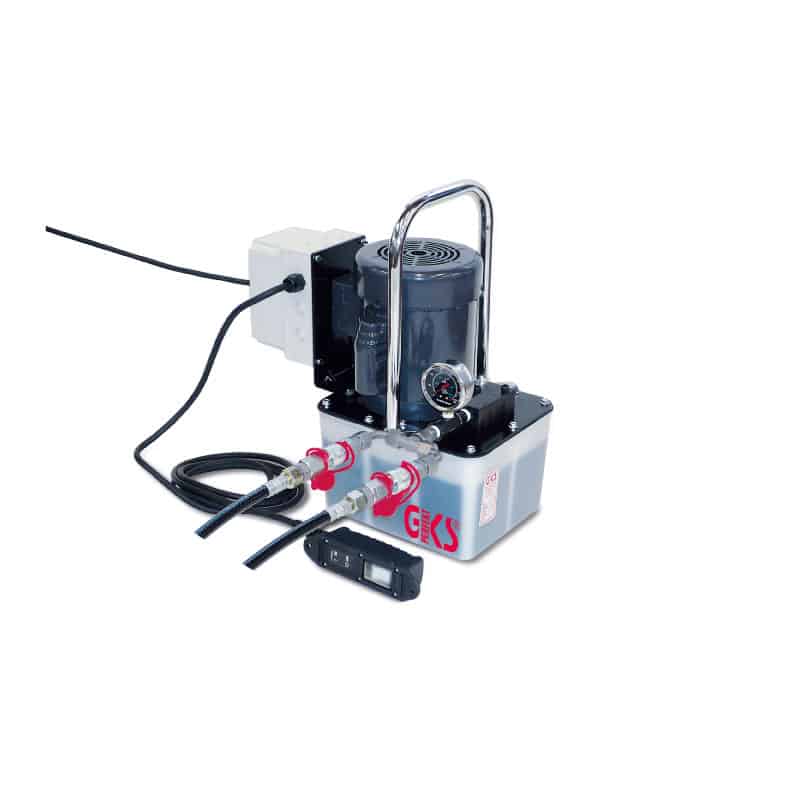
Electric hydraulic pumps are designed for more frequent and demanding lifting operations. They are commonly used in manufacturing, logistics, shipping, and industrial maintenance environments where heavy loads are moved regularly.
These systems significantly reduce manual effort by automating pressure delivery to hydraulic jacks, allowing for faster and less physically demanding lifting operations.
When selecting an electric pump, important factors include reservoir size, system capacity, and valving configuration. Some systems use single-piece manifolds, while others use modular designs that allow for greater flexibility in pressure control between jacks.
Key benefits of electric pumps include:
- Faster and more efficient lifting cycles
- Reduced physical strain on operators
- Improved productivity in high-frequency operations
- Flexible system configurations for different applications
- Enhanced consistency in synchronized lifting
Choosing the Right Hydraulic Pump System
The best hydraulic pump system depends on how often lifting is performed, the size and weight of the loads, and whether electrical power is available at the job site.
For occasional or remote lifting applications, hand pumps often provide the most practical solution. For high-volume or production-based environments, electric hydraulic pumps typically deliver the best long-term efficiency and performance.
In all cases, the goal is the same: safe, controlled, and synchronized lifting that reduces risk while improving operational flow.
Supporting Reliable Synchronous Lifting Systems
Hydraulic pumps are a critical component of any synchronous lift system. When properly matched with lifting jacks and accessories, they help ensure loads are moved evenly, safely, and with minimal disruption to operations.
Across industries such as manufacturing, aviation, rigging, millwrighting, and machine maintenance, hydraulic lifting systems remain a foundational tool for heavy-load handling.
Selecting the right pump system is not just about equipment—it’s about improving safety, reducing downtime, and increasing long-term operational efficiency.
Working with Hydraulic Lifting Systems
Industrial lifting applications often require systems that are not only powerful, but also reliable and adaptable to different job conditions. Factors such as load weight, lifting frequency, jobsite environment, and available utilities all play a role in determining the right configuration.
For teams evaluating hydraulic pump systems or planning upgrades to existing lifting setups, it can be helpful to review available options in detail and ensure compatibility across all components of the system, including jacks, pumps, and control configurations.
GKS industrial moving solutions have supported a wide range of industries where heavy loads must be lifted and transported safely and efficiently. With a focus on engineered lifting systems and long-term reliability, GKS provides hydraulic equipment designed for demanding industrial environments.
To learn more about hydraulic lifting systems and available pump configurations, contact us today.