What are Container Dollies Used For?
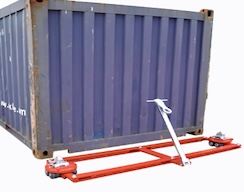
Warehouses, shipping yards, freight terminals, and other businesses rely on container dollies to keep their operations running smoothly and their workers protected from unnecessary strain. Container dollies are specifically designed and engineered to move ISO containers, also called intermodal containers, safely and efficiently from place to place. ISO containers often need to travel from one transport vehicle to another, or in and out of storage. Container dollies make this process safe, quick, and easy.
The Benefits of Container Dollies
Next time you need to move an ISO container, choose a container dolly.
- Unlike forklifts and other heavy-duty equipment, container dollies are designed specifically for ISO and intermodal containers.
- GKS container dollies use specialized, cone-shaped “feet” and a twist lock feature to secure ISO containers in place. These features ensure that containers don’t slip in transit, if a dolly runs over a pothole or a crack in the floor.
- Container dollies move via polyamide rollers. These rollers can handle concrete and asphalt floors, irregular surfaces, and metal grates.
- Container dollies are compact and neatly shaped, allowing for easy storage when not in use.
- Container dollies are more cost effective than heavy equipment and require no fuel to operate.
- Container dollies are not motorized, require less maintenance than a crane or a forklift, and are often more durable.
Thanks to robust German engineering, GKS dollies are manufactured from a simplified design, with no redundant parts.
>>Explore GKS container dollies
It’s worth noting that container dollies do not eliminate the need for heavy machinery entirely. A strong person may be able to pull a dolly loaded with an empty container. But if the container is full, the dolly must be towed by a forklift, forktruck, or tugger. However, a container dolly can eliminate the need for more than one such machine, which can save space, money, and time spent on maintenance.
Container Dolly Alternatives
There are several alternatives to container dollies:
- Forklifts. Many businesses choose to use two forklifts in tandem to transport ISO containers from one place to another. There are several risks, however, to consider with this approach. If one forklift operator loses focus or makes a mistake during the move, the container is at risk of falling. This can lead to significant damage and jeopardize worker safety. Unlike container dollies, forklifts have no means of locking a container in place. If the forklift hits a bump, the container could slip.
- Cranes. Cranes offer the advantage of incredibly high carrying capacity. As long as you have a licensed operator on staff, a crane can be an excellent option. However, cranes can be incredibly expensive. They’re large and awkwardly shaped, making storage inconvenient, especially if space is at a premium.
- Trucks. Many trucks are built specifically for moving intermodal containers. Depending on the application, a truck may be a perfectly suitable method for moving ISO containers. But if you only need to move the container a short distance, a truck may not be the most practical means of transportation.
Explore GKS Container Dollies
All GKS container dollies are the product of first-rate German engineering. GKS container dollies are made with non-marking rollers that won’t damage or scratch surfaces and are protected by a one-of-a-kind boxed-in wheel design to protect the rollers themselves from damage.
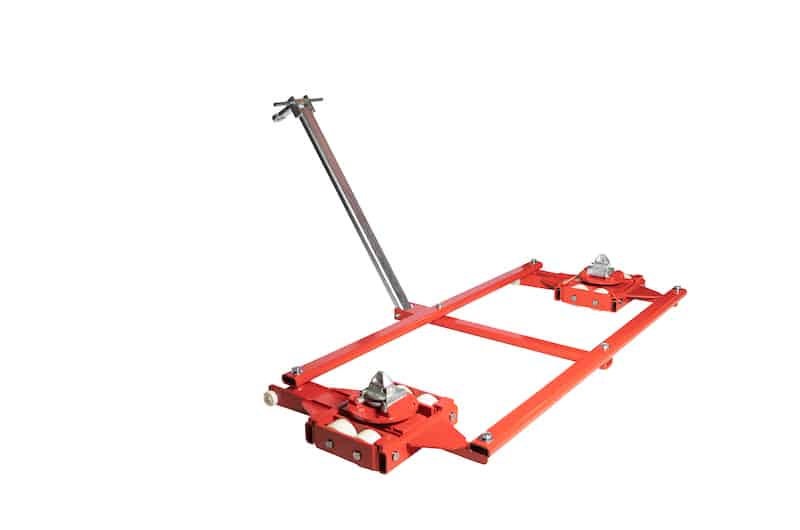
A complete container dolly system consists of two elements: The follow dolly, which is called the “F dolly,” and the tandem-lead dolly, called the “TL dolly.” The F dolly has two straight-line skates, connected by a bar. The TL dolly has a handlebar with a towing eye. The cone fittings on the TL dolly are affixed to swivel plates, to facilitate steering.
6-C Container Dollies
The F6-C and TL6-C dollies have a load capacity of 13,200 pounds or six tons and a loading height of seven inches. Together, they weigh a total of 278 pounds.
12-C Container Dollies
The F12-C and TL12-C dollies can carry up to 26,500 pounds or 12 tons. Like the 6-C dollies, the 12-C dollies have a seven-inch loading height.
20-C Container Dollies
The F20-C and TL20-C have the highest loading height of any GKS container dolly system, at 8.86 inches. The 20-C dollies have a carrying capacity of up to 20 tons, or 44,000 pounds.
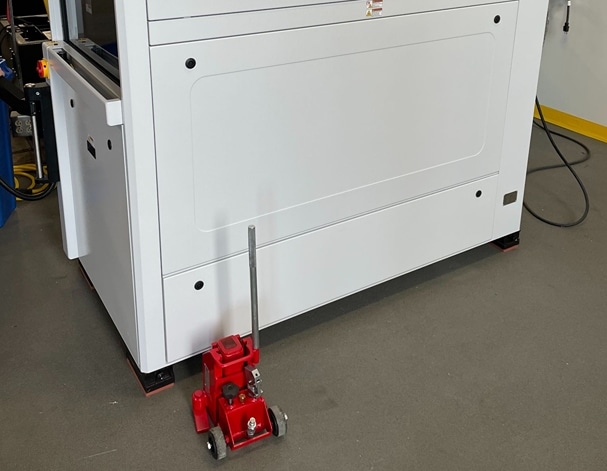
GKS container dollies work beautifully in tandem with GKS’s line of hydraulic toe jacks.
★ GKS is proud to offer a five-year warranty on all container dollies and industrial moving equipment. Every single unit made by GKS is subject to extensive testing to ensure proper function and optimized performance. ★
To learn more about container dollies and other moving solutions from GKS, talk to a member of our US-based customer service team.